Do you know how much compressed air waste is costing your operation?
Every time your conventional air-operated double-diaphragm (AODD) pump completes a stroke, a small amount of compressed air escapes into the atmosphere. Do it a thousand times an hour, across multiple pumps, around the clock, and that invisible waste becomes one of the largest lines in your operating budget.
This blog helps engineers and facility managers evaluate and compare AODD pump energy costs and explains how the industry’s premier air distribution system helps prevent compressed air waste at the source.
Why AODD Pump Energy Costs Matter More than Ever
Electricity prices for industrial operators are steadily rising, and compressed air is one of the most energy-intensive utilities in any plant.
Consider the following:
- Industrial pumping systems account for nearly 20% of the world’s total electricity demand (Sulzer)
- Energy costs can represent up to 90% of a pump’s total lifetime operation costs (Hydraulic Institute)
- An estimated 30-50% of pump energy consumption can be eliminated through equipment or control-system upgrades, without sacrificing output (EnergyRight)
At the same time, sustainability is no longer a buzzword that is used flippantly. According to KPMG’s 2020 Survey of Sustainability Reporting, 80% of the world’s leading companies are now formally tracking and reporting on sustainability efforts. For many facilities, choosing energy-efficient equipment is about cutting costs and meeting real operational and environmental commitments.
Pump selection is one of the highest-leverage decisions a plant manager or engineer can make, and getting it right can mean the difference between an energy-draining pump and one that saves you money.
What is an AODD Pump and How Does it Use Energy?
An AODD pump uses compressed air as its power source. Here’s how it works:
- Compressed air alternately pressurizes two chambers inside the pump
- That pressure flexes two diaphragms back and forth
- Each flex draws fluid in one side and pushes it on the other side
- The cycle repeats continuously to maintain flow
Because they run on compressed air rather than direct electricity, AODD pumps are widely used across industries, including:
The key takeaway: The cost of running an AODD pump is measured in compressed air, not kilowatt-hours. In other words, your compressor is what consumes the electricity, and it works continuously to supply the air that drives the pump. That’s why understanding how much air a pump consumes is the foundation of any energy cost comparison.
How to Compare the Energy Costs of AODD Pumps?
When comparing AODD pumps, the single most important factor affecting energy cost is the air consumption rate or Standard Cubic Feet per Minute (SCFM).
To accurately calculate the energy consumption of an AODD pump, it is best to measure the horsepower required to generate the compressed air that powers it. This requirement is based on two primary variables: the SCFM, which is generally obtained from the pump’s performance curve, and the air pressure (psi) the compressor must overcome. The following equation provides an estimate for this demand:
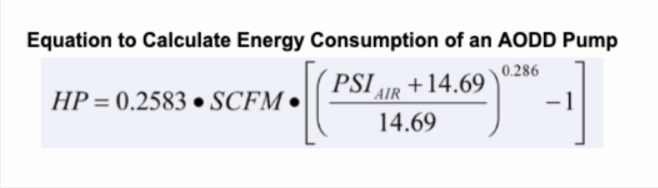
Most industrial compressors operate between 100 and 125 psi, cycling on when tank pressure drops to around 100 psi and shutting off at roughly 125 psi. When the compressor kicks on, it’s already working against the existing pressure in the tank, meaning energy costs are directly tied to how often and how hard it has to run to refill it.
A common misconception is that regulating the air to a lower operating pressure reduces energy consumption. It doesn’t. The energy was already spent compressing the air to storage pressure at the compressor. Throttling it down at the pump doesn’t recover that energy.
The key takeaway: When comparing AODD pumps delivering equivalent flow rates, the only variable that affects energy costs is SCFM. Lower air consumption equals lower operating cost.
Why Traditional AODD Pumps Waste Compressed Air?
To understand why some pumps are more efficient than others, it helps to know where the waste actually comes from: overfilling.
In a conventional AODD pump air distribution system (ADS), there’s an inherent time delay when pressurized air switches between chambers. During that delay:
- Air continues flowing into the chamber even after the stroke is complete
- The chamber overfills
- Excess air is then vented directly into the atmosphere
- The energy is gone, paid for and wasted, stroke after stroke, hour after hour
How the Wilden® Pro-Flo® SHIFT Air Distribution System Minimizes Compressed Air Waste
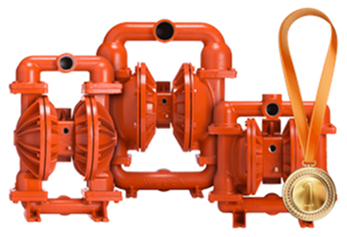
Featuring the industry’s premier air distribution system, Wilden Pro-Flo SHIFT AODD Pumps are engineered to eliminate overfilling waste. Here’s what makes the Pro-Flo SHIFT ADS different:
- To ensure only the precise volume of air needed to maintain the pumping cycle reaches the chamber, the system utilizes an internal air-control spool for metering
- This technology curbs the waste of compressed air by blocking excess entry into the chamber, maintaining consistent fluid output
- Up to 60% less compressed air compared to conventional AODD pump technologies
- Up to 34% higher flow rates than competitive AODD models
Spanning a wide range of industrial applications, the Pro-Flo SHIFT Series is available in sizes from ½” to 4” and is offered in both plastic and metal constructions, with clamped or bolted configurations.
What to Look for When Comparing AODD Pumps on Energy Cost
Before selecting an AODD pump, use this checklist to make sure you’re making a true comparison:
Get SCFM at your actual operating conditions. Pull air consumption from the pump’s performance curve at your real-world operating pressure and flow rate.
Normalize for flow rate. Only compare SCFM figures for pumps delivering the same GPM. A pump that uses less air but moves less fluid isn’t a fair comparison.
Factor in your compressor efficiency. Your compressor’s horsepower draw per SCFM determines actual electricity cost. Use your facility’s compressor specs for the most accurate numbers.
Calculate based on your run hours. A pump running 24/7 will see dramatically greater savings from an efficient ADS than one running a few hours per shift. The higher the utilization, the faster the payback.
Check for utility rebates. A pump upgrade with documented energy saving may qualify for a rebate that reduces your costs. Contact your provider to see if they have rebate programs.
Demand documented performance data. A reputable manufacturer provides certified pump curves. If a provider can’t back up an efficiency claim with hard data, you may want to treat it with skepticism.
How Much Can Wilden Pro-Flo SHIFT AODD Pumps Save You?
The Wilden Pro-Flo SHIFT savings calculator shows how much the industry’s leading air distribution system can help cut from operation costs. Just enter a few details about your application and see your potential savings.
Looking to learn more about how Wilden Pro-Flo SHIFT AODD Pumps can help reduce your energy consumption? Read our whitepaper: Choosing the Right AODD Pump Can Reduce Energy.
For more information on how the Pro-Flo SHIFT Series can save you money in your specific application, please contact your local distributor or click here to fill out our contact form.